Aliso Viejo, CA • Furnace / Heater Repair
Furnace / Heater Repair in Aliso Viejo, CA
Aliso Viejo winters are mild, but a furnace that will not heat on a cold night still needs a clear diagnosis. We repair gas and electric furnaces and heaters across Aliso Viejo.
24/7 emergency line • Local Aliso Viejo coverage • Clear diagnosis first
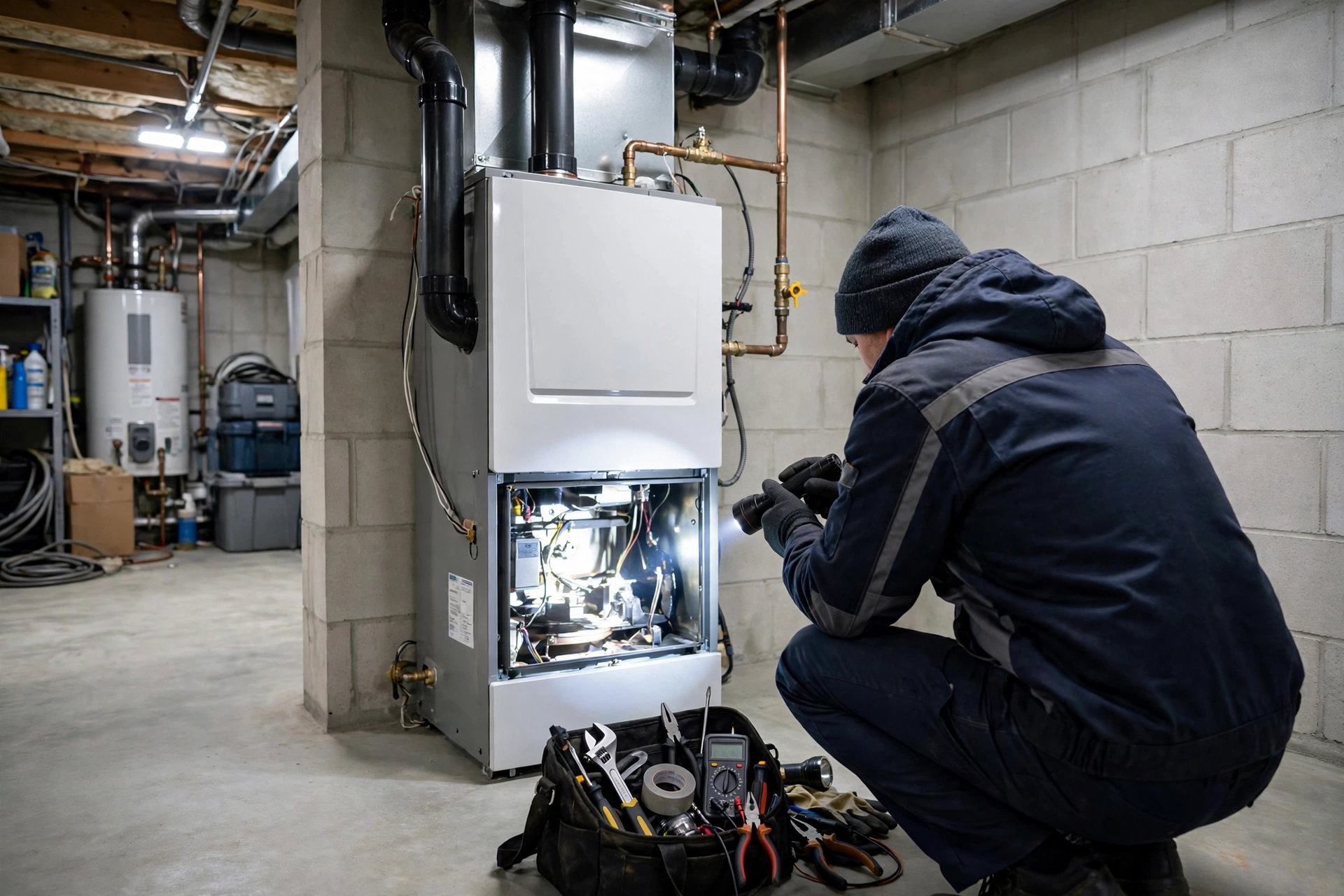
Aliso Viejo winters are mild, with lows around 46 to 47 degrees and temperatures rarely below 42, so the furnace works far less than the air conditioner. That is exactly why furnace faults catch homeowners by surprise: the system sits idle through the long warm season, then fails on the first cold night of the year. Many Aliso Viejo homes still run the furnace they were built with in the 1980s, 1990s, or early 2000s, and after decades of seasonal use the ignition, the control board, and the blower are the parts most likely to fail.
Furnace repair starts with the symptom, not the part. A furnace that will not start, one that blows cold air, and one that starts and stops every few minutes are three different problems with three different causes. A repair visit narrows the fault down step by step: thermostat, power, ignition, gas or electric supply, airflow, and controls, before any part is changed.
No Heat and a Furnace That Will Not Start
No heat is the most urgent furnace fault, and callers describe it in plain words: the heater is not working, there is no heat since yesterday, or it is freezing with no heat in the house. The words change, but the problem is the same: a furnace that should be warming the home is not.
When a furnace will not start at all, the words we hear are direct: it just will not turn on, it does not kick on, or the heater will not work and will not turn on at all. Power comes first in the check: the furnace switch, the breaker, and the control board. A tripped breaker or a switched-off furnace switch is a quick fix, and a technician checks those before looking deeper.
Some no-heat calls are about heat never arriving where it should. A caller may say there is no heat on the first floor, or that the heat is not kicking on upstairs. The fix depends on what the furnace is doing when it is asked to run, so the technician watches a full heating cycle and notes where it stops.
Furnace Blowing Cold Air
A furnace that runs and blows cold air is a different fault from one that will not run. Callers say the AC works perfectly, but when the system is set to heat, it only blows cold air. The blower is moving air, but the burner or the heating element is not adding heat.
On a gas furnace, cold air can mean the burner never lit: the igniter may be worn, the gas valve may not have opened, or the flame sensor may have shut the burner down. On an electric furnace, it can mean a heating element or sequencer has failed. The technician tests the ignition sequence step by step to find where it stops.
Cold air can also come from the thermostat or the fan setting. A fan set to run all the time moves room-temperature air between heating cycles, and that air feels cold at the vent even when the furnace is fine. Ductwork matters too: air that leaves the furnace warm can arrive cool if ducts run through an unheated attic and lose heat along the way.
Short Cycling, Ignition, and Control Board Faults
Short cycling means the furnace starts, runs for a short time, and stops before the home warms. Callers describe it in plain words: it turns on and then turns off after a couple of minutes, it came on but then it quit, or it starts but has to be made to start multiple times. A clogged filter, a faulty limit switch, or a flame sensor that cannot prove the flame are the usual causes.
Ignition faults leave the burner dark while the rest of the furnace tries to run. Callers say the furnace is not igniting and there is no heat going out, or that the furnace is not firing. The igniter may be worn, the pilot may not light, or the gas valve may not open. The control board runs this sequence, and when it fails the sequence stops.
The control board is the part behind several of these faults. Callers describe it as the main control board not connecting, or ask for someone to look at the heater to see if the central board can be repaired. The technician tests the board's signals before replacing it, because a board fault and a sensor fault can look the same from the outside.
Gas Smell Safety and When to Call for Help
A gas smell around the furnace is a safety matter first and a repair second. Callers have told us they were smelling gas, and that the gas had been turned off to the furnace. If you smell gas, leave the house, do not switch lights or appliances on or off, and call the gas utility from outside. Do not try to restart the furnace.
Once the gas supply is safe, a technician can find the source of the smell: a loose fitting, a cracked heat exchanger, or a valve that is not closing fully. A furnace with a gas leak should not be run until the leak is found and fixed, and the technician tests every joint and valve before the system is put back into service.
For other furnace faults, the call is simpler. Note what the furnace does when it tries to run: nothing, cold air, or a short cycle. That detail shapes the diagnosis, and it helps the technician arrive with the right parts. Call Aliso Viejo HVAC Pros at (949) 555-0100 to arrange a furnace repair visit.
Frequently Asked Questions
Why is my furnace running but my home still feels cold?
The furnace may be short cycling, the burner may not be lighting, or the filter may be choking airflow. A technician checks the burner, the filter, and the thermostat setting in turn, because each one produces the same cold-house symptom for a different reason.
My furnace turns on and off every few minutes. What causes that?
That pattern is called short cycling, and a clogged filter, a faulty limit switch, or a flame sensor that cannot prove the flame are the usual causes. The technician watches a full cycle to see where it stops, then tests the part that should have acted.
What should I do if I smell gas near my furnace?
Leave the house, do not switch lights or appliances on or off, and call the gas utility from outside. Do not try to restart the furnace until the leak has been found and fixed.
How do I know if the problem is the thermostat or the furnace?
If the thermostat screen is blank or the display shows no power to the red wire, the fault is often at the thermostat or its wiring. If the thermostat calls for heat and nothing at the furnace responds, the fault is at the furnace.
Why does my furnace not ignite?
The igniter may be worn, the gas valve may not be opening, or the control board may not be running the ignition sequence. The technician tests each step of the sequence to find where it stops.
Is my furnace gas or electric?
Most Aliso Viejo furnaces are gas, with some electric systems in homes without a gas supply. The data plate on the furnace states the fuel type, and callers often clarify it at the start, which tells the technician which system to expect.
HVAC Repair in These Aliso Viejo Neighborhoods
This service is available across Aliso Viejo, including:
- HVAC Repair in California Summit, Aliso Viejo, CA
- HVAC Repair in Glenwood, Aliso Viejo, CA
- HVAC Repair in Pacific Ridge, Aliso Viejo, CA
- HVAC Repair in Westridge, Aliso Viejo, CA
Related Services
Call (949) 555-0100 any time — 24/7 emergency line — to talk through your HVAC problem in Aliso Viejo and book a visit.
HVAC Problem in Aliso Viejo? Call Now.
Inspection first. Honest answers. Repair and replacement by local providers.
Call (949) 555-0100